
Tracing the Invisible Thread
I had always longed to wander the world – to glimpse the countless ways in which different cultures, across their long or fleeting histories, discovered their own paths for expressing the universal human truths.
I began my journey into painting in my teenage years, following the paths traced by contemporary art history.
And yet something was missing. Something more intimate and at once bound to the greater weave of Life itself. Something that could tie me back to my grandmother’s paradoxical tales – stories from another place and another time, where the veil between myth and reality is forever pierced by wonder. A faint, unseen thread seemed to run through my soul. A thread stretching back to those ages before History took shape, still perceptible in Folk Art and in the remnants of the ancient and medieval Arts of my homeland.
As I delved deeper, I came into contact with the astonishing ways in which civilizations evolve, and with the movement of the elements and ideas as they flow between different cultures.
Movement, nothing in human societies has ever been static or “pure”. Without the blending of diverse elements, there is no continuity, no growth, no evolution for the human spirit. Those very elements of cultural evolution are like genes of human consciousness – rearranging themselves, mingling or parting ways, altering what once existed, and making space for what is yet to come. On a collective level, they weave the multicolored tapestry of the World.

Tradition as a Living Continuum
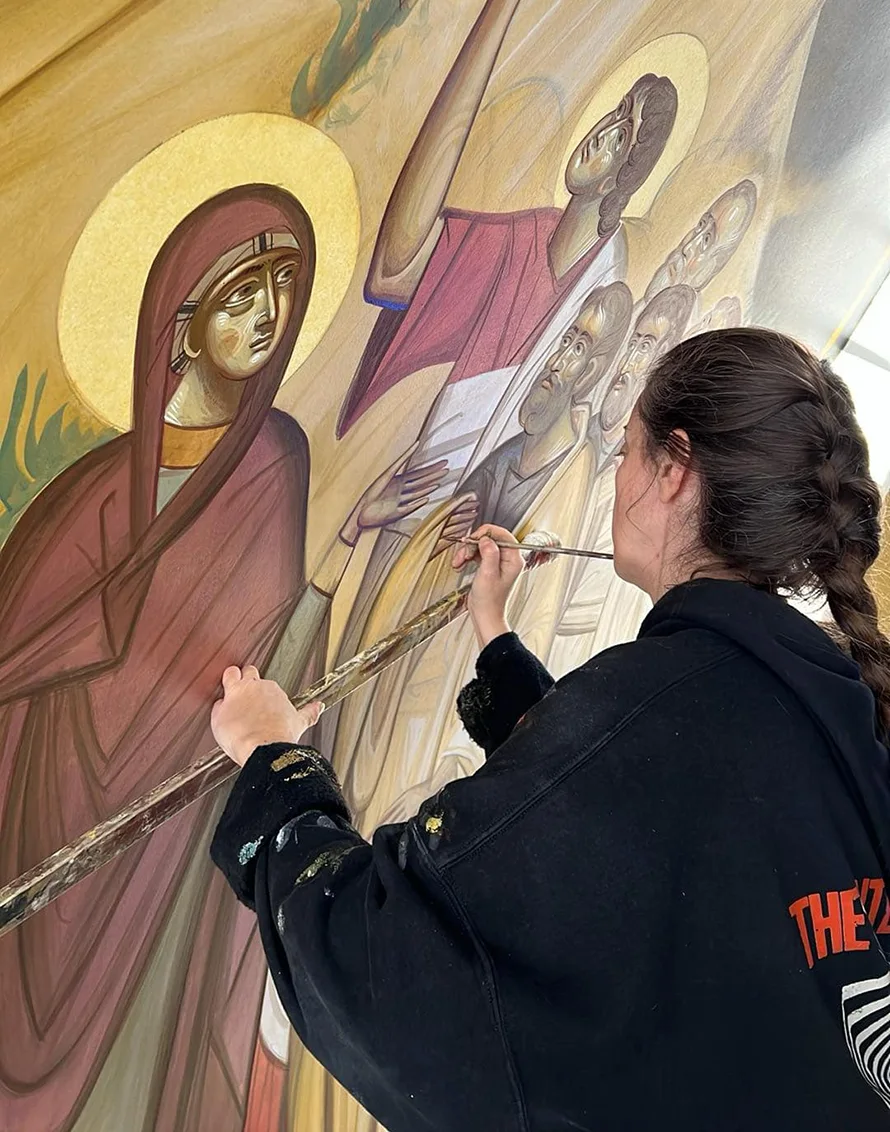
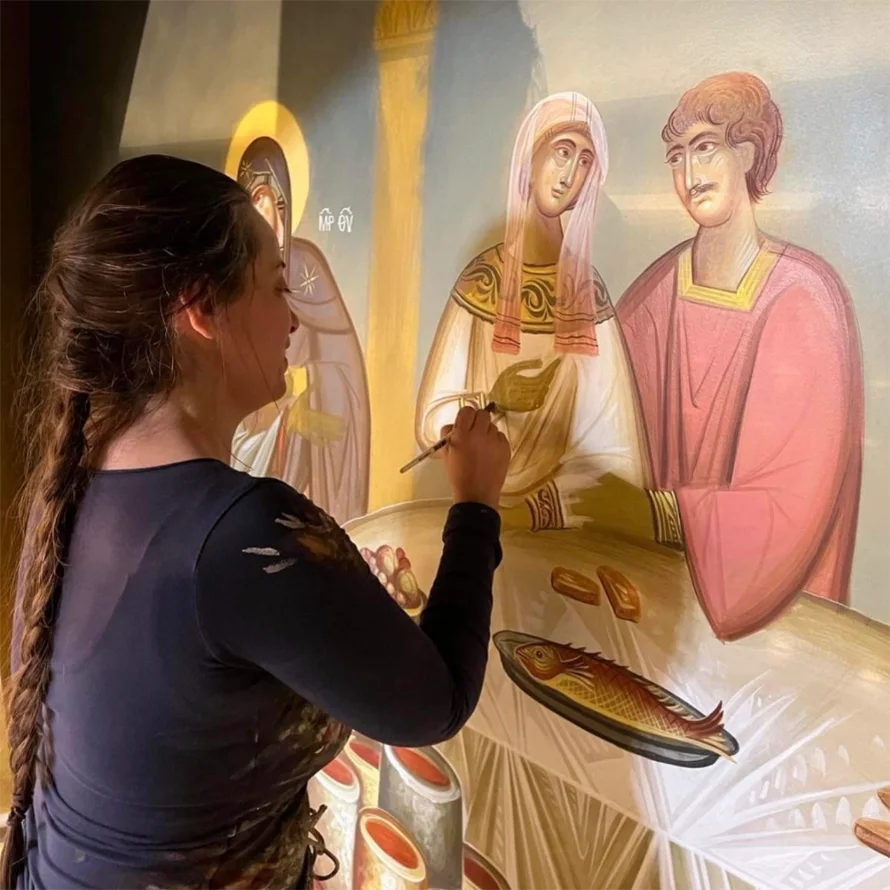
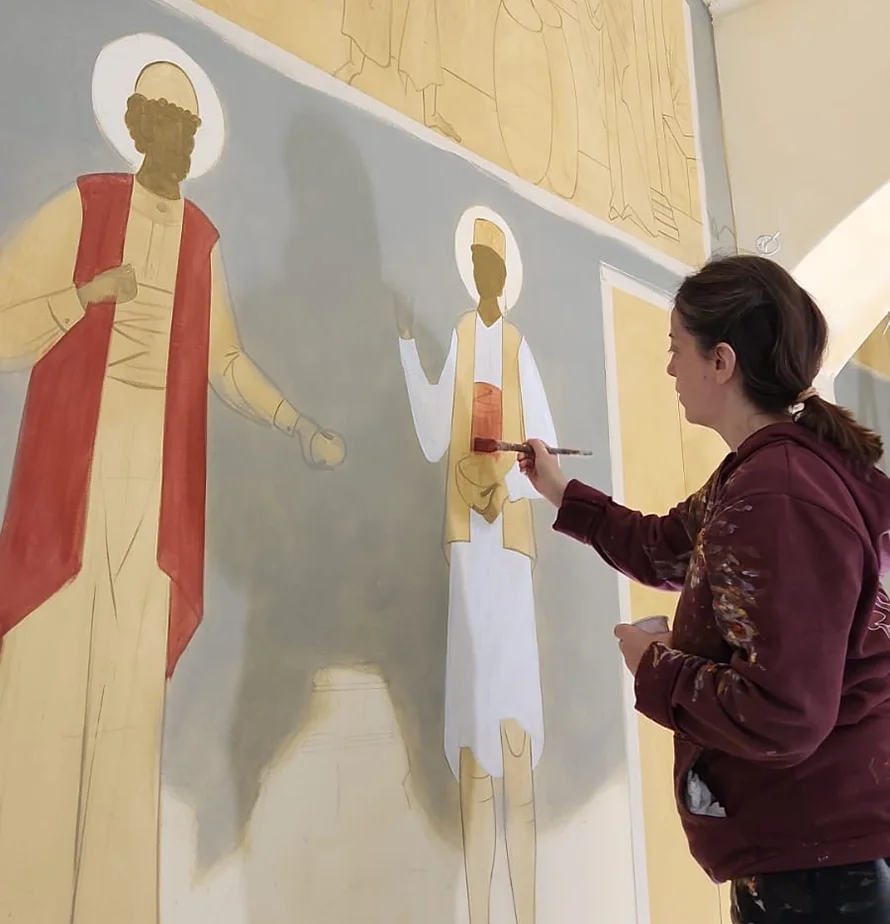
Byzantine art is a visual language born through the altered shape of human consciousness after Alexander the Great changed the borders of the ancient world. It combines in a unique way features and elements from eastern and western origins, as well as abounds with philosophical or folk beliefs and practices of an Era long gone, but somehow still present.
Across the ancient Greek land, a century-long visual tradition unfolds. A cultural evolution ultimately gives birth to the Byzantine mode. This painting tradition evolves not in a linear way but through cyclical rhythms, in its negations and affirmations. At the same time, this art form preserves a seamless line, an inner continuity, independent of the form features of its era.
This visual narrative language is constructed in such a way as to contain and unfold within the spectators’ own time. The story has been told, becomes present, embracing not only the individual, but the community as a whole.
This is achieved through abstraction, stylization of the forms, through inverse perspective, inner rhythm, and other elements, which allow this mode of painting to transcend the boundaries of mere representation and to subdue the natural world to the enchantment of the narration.
Every land gives birth to its own distinct mode of expression, shaped through the flow of history and the interchange with neighboring cultures. These «traditional» paths of artistic creation, formed, in a sense, through a kind of «natural selection». They address not only to the individual, but to the collective dimension of the human being. They trace their orbits around the hidden bodies of Myth, deep within the human soul. They act on the elusive landscape of the present time, touching that common essence shared between the prehistoric and the contemporary human being.
The existence and continuity of cultural diversity is as vital to the growth of human consciousness as biodiversity to the continuity of Life itself.
In a world fluid and profoundly subjective, almost devoid of aesthetic measurement and criteria, Art has become an artificial byproduct of our conceptual approach to the world and to ourselves.
The traditional arts, with their seamless continuity from prehistory into the future, offer a different vision of what Art can be or how it may function. They raise questions about the nature of the relationship between the individual and the social whole and about the public function of Art.
When Pablo Picasso visited the famous cave paintings of Altamira cave, he stated that: «After Altamira all is decadence… in 15000 years we have invented nothing». Even if we don’t share his dismissive opinion on the evolution of human intellect and consciousness, one thing is certain: the primordial will outlive New York.
The journey through the ancient narrative arts of the world is a journey within the human psyche, from its primordial origins to the future human being.